
BLOG

Behind the numbers.

Code examples, market analysis, and data quality deep-dives.

How to Get Historical Market Cap Data in Python
How Much of the S&P 500 Survives 20 Years? Index Turnover Analysis in Python
Does Joining the S&P 500 Bring New Institutional Owners? 13F Event Study in Python
Is Volatility Seasonal? Calendar Month Analysis of Realized Volatility in Python
Does Fast Revenue Growth Force Companies to Borrow? Cash Funding Analysis in Python
How Far Back Does SEC EDGAR Data Go?
Are One-Time Charges Really One-Time? Charge Frequency Analysis in Python
Does Buying the Dip Work? Short-Term Reversal by Volatility Regime in Python
Alpha Vantage vs Massive vs xfinlink for Fundamentals
How Long Does a Stock Take to Recover From a 50% Fall? Drawdown Analysis in Python
Do Companies That Shrink Their Share Count Outperform? Net Buyback Yield in Python
How Much Does the Dow's Price Weighting Distort It? Index Weighting Analysis in Python
How to Get SEC Form 4 Insider Trading Data in Python
Can Anything Predict Next Month's Stock Returns? Out-of-Sample R-Squared Testing in Python
How Much of a Stock's Return Comes From Its Sector? Variance Decomposition in Python
Altman Z-Score: Where To Get It in Python
Do Value Screens Agree on Which Stocks Are Cheap? Multiple Overlap Analysis in Python
Annual vs Quarterly Financial Data: Which to Use
Do High Returns on Capital Persist? ROIC Fade Analysis in Python
Does Past Beta Predict Future Beta? Beta Stability Testing in Python
Do Defensive Sectors Actually Defend? Up and Down Capture in Python
How to Choose a Financial Data API
Do Small Caps Actually Beat Large Caps? Size Premium Test in Python
What If You Miss the Market's Best Days? Extreme-Day Analysis in Python
Does Rebalancing Add Return? Fixed-Weight vs Drift Portfolios in Python
Which S&P 500 Companies Are Closest to Default? Merton Distance-to-Default in Python
What Happens to Stocks Removed From the S&P 500? Replacement Pair Analysis in Python
Does the Golden Cross Work? 50/200 Moving Average Crossover Backtest in Python
Financial Data for Academic Finance Research
Does Skipping the Most Recent Month Improve Momentum? S&P 500 Decile Sorts in Python
Does Cointegration Survive Out of Sample? Pairs Trading Validation in Python
Which Dividends Are Not Covered by Cash? Free-Cash-Flow Coverage Screening in Python
GICS vs SIC vs NAICS: Which Industry Classification to Use
How Many Stocks Does It Take to Diversify? Random Portfolio Simulation in Python
How Many Days of Data Does a Volatility Estimate Need? Range-Based Estimators in Python
How Much of S&P 500 Cash Flow Is Stock Compensation? Cross-Sectional Analysis in Python
What Is a 13F Filing? Institutional Holdings Explained
Does Revenue Growth Explain Profit Growth? Cross-Sectional Decomposition in Python
How Much of the Nasdaq 100 Is Already in the S&P 500? Index Overlap Analysis in Python
How Often Does a 99% Value-at-Risk Limit Actually Break? VaR Backtesting in Python
Real-Time vs End-of-Day Market Data: Which Do You Need?
How Concentrated Are S&P 500 Earnings? Point-in-Time Index Analysis in Python
Does Volatility Scale With the Square Root of Time? Variance Ratio Test in Python
Does Goodwill Distort the Price-to-Book Screen? Goodwill-Adjusted Valuation in Python
How Are Shares Outstanding Reported (and Why They Disagree)
Do Low-Volatility Stocks Deliver Better Risk-Adjusted Returns? S&P 500 Quintile Sorts in Python
Does Trend Following Beat Buy and Hold? Time-Series Momentum in Python
Has the Stock-Bond Correlation Flipped? 60/40 Portfolio Risk in Python
What API to Use for a Stock Screener
Which Assets Hedge Inflation Shocks? Macro Factor Betas in Python
Does Covariance Shrinkage Beat the Sample Covariance? Minimum-Variance Portfolios in Python
Do Faster Inventory Turns Mean Thinner Margins? Gross Margin Return on Inventory in Python
SEC EDGAR API vs Fundamentals API: Which to Use
Does Fast Earnings Growth Persist? Rank Correlation Analysis in Python
Split Adjustment Explained: Adjusted Close vs Close
Which Trading Day of the Month Pays Best? Turn-of-the-Month Analysis in Python
Can You Use Yahoo Finance Data Commercially?
How Many Independent Bets Does a Nine-Sector Portfolio Give You? Eigenvalue Analysis in Python
Which Volatility Forecast Wins One Month Ahead? HAR vs EWMA in Python
How Concentrated Are Institutional Equity Portfolios? Form 13F Concentration Analysis in Python
Do Stocks Earn Their Returns Overnight or Intraday? Return Decomposition in Python
When Do Corporate Insiders Actually Trade? Form 4 Timing Analysis in Python
Data Requirements for Backtesting a Trading Strategy
What Is Survivorship Bias in Backtesting?
Do High Dividend Yields Come From Bigger Payouts or Falling Prices? Yield Decomposition in Python
Do Stocks Fall Harder Than They Rise? Downside Beta vs Upside Beta in Python
Does Volatility Targeting Improve Sharpe Ratios? Seven-Asset Backtest in Python
Free Stock Market Data APIs: What You Actually Get
How to Give an LLM Financial Data With an MCP Server
Does Post-Earnings Announcement Drift Survive Real Filing Dates? PEAD Event Study in Python
Do Insider Buying Clusters Predict Returns? Signal Testing in Python
Does the S&P 500 Index Effect Still Exist? Event Study in Python
Are Companies Leaving the S&P 500 Faster Than They Used To? Index Survival Analysis in Python
Does Gross Profitability Predict Stock Returns? Quintile Factor Test in Python
What Growth Rate Is the Market Pricing In? Reverse DCF in Python
Does a Strong Balance Sheet Cushion Drawdowns? Leverage and Downside Risk in Python
Does Ticker Recycling Corrupt a Mean-Reversion Backtest? Entity-Resolved Z-Scores in Python
How Much of a Growth Screen's Backtested Edge Is Survivorship Bias? Point-in-Time Index Testing in Python
Why Do Leveraged ETFs Decay? Measuring Volatility Drag in Python
Are Consumer Staples Margins Shrinking Under Inflation? Gross Margin Trend Analysis in Python
Do Weak Jobs Reports Predict Market Drawdowns? NFP Surprise Event Study in Python
Is the Rotation From Tech to Industrials Backed by Earnings? Relative EPS Growth Analysis in Python
Is the Semiconductor Rally Broadening Beyond NVIDIA? Return Dispersion Analysis in Python
Which Stocks Benefit Most When Oil Prices Fall? Oil Beta Screening in Python
Do Bond Returns Predict Stock Returns? Granger Causality Test in Python
Which Stocks Actually Drive Portfolio Returns? Shapley Value Attribution in Python
Does "Sell in May" Still Work? Calendar Anomaly Backtest in Python
How to Build Complete Price History Through Ticker Changes? Entity Resolution in Python
Are KO and PEP Cointegrated? Pairs Trading Signal Construction in Python
Which Commodities Have the Strongest Momentum? Rotation Backtest in Python
Which Commodity ETFs Have the Worst Tail Risk? Expected Shortfall in Python
Are Gold Miners Leveraged Gold Bets? Rolling Beta Analysis in Python
Does the Base-Metals-to-Gold Ratio Lead Cyclical Stocks? Signal Test in Python
Can Risk Parity Tame Commodity Volatility? Portfolio Optimization in Python
Are Power Stocks Becoming an AI Infrastructure Trade? Momentum Screening in Python
Which AI Chip Stocks Have Margin Momentum? Profitability Trend Analysis in Python
Which AI Stocks Are Cheapest Relative to Growth? Growth-Adjusted Valuation in Python
Does AI Stock Leadership Persist? Momentum Backtest in Python
Which AI Stocks Have the Cleanest Balance Sheets? Net Cash Screening in Python
Can Risk Parity Reduce Mega-Cap Drawdowns? Portfolio Optimization in Python
Which Growth Stocks Are Self-Funding? Cash-Flow Quality Screening in Python
Which Sectors Struggle When the Dollar Rallies? Sector Rotation Analysis in Python
Do Cheap Stocks Hold Up When Bonds Sell Off? Valuation Rotation in Python
Does the Nasdaq 100 Have Better Growth Quality Than the Dow? Index Constituent Analysis in Python
Do Healthcare Cash-Flow Margins Predict Returns? Signal Evaluation in Python
Which Dividend Stocks Survive a Cash-Flow Stress Test? Dividend Screening in Python
Does Heavy Insider Selling Predict Weak Returns? Insider Flow Test in Python
Can Quality Screens Reduce Small-Cap Balance-Sheet Risk? Russell 2000 Test in Python
Which Retailers Have Positive Operating Leverage? Margin Screening in Python
Is MSTR a Leveraged Bitcoin Proxy? Rolling Beta Analysis in Python
Is Micron's Memory Cycle Recovering? Inventory and Margin Forecasting in Python
Which Sectors Work When Bonds Rally? Rate-Sensitive Rotation in Python
Do One-Month Price Extremes Reverse? Signal Evaluation in Python
Do Low-Volatility S&P 500 Stocks Reduce Drawdowns? Factor Test in Python
Is AI Capex Paying Back Fast Enough? Revenue Hurdle Forecasting in Python
Could Shorter AI Asset Lives Hit Earnings? Depreciation Stress Test in Python
How Much AI Capex Risk Can a Portfolio Remove? Constrained Optimization in Python
Is the AI Capex Trade Crowded? Rolling Volatility and Sector Rotation in Python
Did the AI Boom Come From Existing S&P 500 Members? Point-in-Time Momentum Test in Python
Is AI Revenue Circular? Customer-Vendor Capex Loop Analysis in Python
Is the AI Trade Connected to Private Credit? Rolling Correlation Network in Python
Is Apollo More Balance-Sheet Sensitive Than Peers? Leverage Screen in Python
Are AI Earnings Supported by Cash Flow? Accrual and Capex Screen in Python
Can Defensive Stocks Hedge AI Drawdowns? Basket Regime Test in Python
How Fast Does the Market Price In Fed Decisions? FOMC Event Study in Python
How Much Are Options Sellers Overpaid? The Variance Risk Premium in Python
Which Companies Have the Worst Earnings Quality? Sloan Accrual Screen with Geographic Revenue Data in Python
Does the Oil-to-Gold Ratio Signal Recessions? XLE/GLD Backtest in Python
Is AI Spending Crowding Out Free Cash Flow? Capex Sustainability Across the Mag 7 in Python
Does a Long Energy / Short Bonds Portfolio Capture Inflation Surprises? Factor Construction in Python
Can a Hidden Markov Model Detect Oil Market Regimes? HMM Analysis in Python
Do Grain Prices Predict Food Inflation? Granger Causality Test in Python
Does the Corporate Credit Spread Predict Stock Market Crashes? BAA-AAA Spread Analysis in Python
Do Oil Stocks Hedge Inflation? Rolling Beta Analysis in Python
Which Stocks Are Most Rate-Sensitive? Equity Duration via Bond Beta in Python
Which Companies Have the Highest Accrual Ratios? Earnings Quality Screening in Python
Is Alpha Persistent or Decaying? Rolling Sharpe Ratio Analysis in Python
Are Markets Trending or Mean-Reverting? Hurst Exponent Analysis in Python
Is Consumer Discretionary vs Staples a Leading Indicator? XLY/XLP Ratio Analysis in Python
Does Heavy Capex Predict Future Stock Returns? Capital Expenditure Analysis in Python
How to Estimate Cost of Equity Using CAPM in Python
Is Volatility Predictable? Testing for Volatility Clustering in Python
Which Industrials Are Overleveraged? Net Debt to EBITDA Screening in Python
GM Before and After Bankruptcy: Why Entity Resolution Matters for Financial Data
What Is Adjusted Beta? Merrill Lynch Beta Shrinkage in Python
How Good Is a Stock Pick? Information Ratio and Tracking Error in Python
Do Stock Returns Follow a Normal Distribution? Testing for Fat Tails in Python
Which Large Caps Have the Highest Free Cash Flow Yield? FCF Screening in Python
Which Sectors Won Over 5 Years? Sector Rotation Analysis in Python
How to Forecast Stock Volatility with GARCH Models in Python
Are Stock Prices Mean-Reverting? Augmented Dickey-Fuller Test in Python
How to Calculate CAPM Alpha and Beta with Regression in Python
How to Compare Sector Sharpe Ratios and Sortino Ratios in Python
DELL: Why Stitching Historical Price Data Together Is Wrong
How to Analyze Drawdown and Recovery for Bank Stocks in Python
How to Screen SaaS Stocks by Revenue Growth and Cash Flow in Python
How to Screen REITs by Dividend Yield and Valuation in Python
How Correlated Are the Magnificent 7? Intra-Group Correlation in Python
AAPL vs XOM: Do Individual Stocks Have Seasonal Patterns?
How to Rank Large-Cap Stocks by Momentum in Python
How to Build a Multi-Endpoint Financial Dashboard in Python
How to Compare Volatility Across Energy Stocks in Python
How to Screen Healthcare Stocks by Valuation in Python
How to Build a Sector Correlation Matrix for Portfolio Diversification in Python
How to Find Oversold and Overbought Stocks Using Z-Scores in Python
How to Measure Earnings Quality: Cash Flow vs Net Income in Python
How to Build a Multi-Factor Stock Screen in Python (Value + Momentum + Quality)
How to Build a Simple DCF Model for Any Stock in Python
How to Screen Tech Stocks by Revenue Growth in Python
How to Screen Stocks by Balance Sheet Health in Python
Is "Sell in May" Real? SPY Monthly Seasonality Over 10 Years
How to Compare Sector Performance YTD Using Python
How to Screen Dividend Stocks by Yield and Quality in Python
How to Calculate Max Drawdown and Recovery Time for Any Stock in Python
How to Compare Profitability Across Mega-Cap Tech Stocks in Python
Why Ticker Symbols Are Unreliable: The Recycling Problem Every Quant Should Know
How to Calculate and Compare Stock Volatility in Python
How to Screen Blue-Chip Stocks by P/E Ratio in Python
How to Track Companies Through Ticker Changes, Bankruptcies, and Renames in Python
S&P 500 Turnover: How Much the Index Has Changed Since 2010
How to Calculate Stock Beta and Correlation in Python
← All articles

How to Build Complete Price History Through Ticker Changes? Entity Resolution in Python

What's the question?

A ticker symbol is a label, not an identity. The symbol "FB" once belonged to BankBoston Corp, then Falcon Building Products, then FBR Asset Investment Corp, and finally Meta Platforms. The symbol "GM" belonged to General Motors Corporation until it went bankrupt in 2009, then to a legally distinct successor, General Motors Company, after its 2010 IPO. The symbol "DELL" belonged to Dell Inc until it went private in 2013, and then to Dell Technologies Inc when it re-listed in 2018.

Naively treating a ticker as a stable identifier creates silent data corruption. Stitching GM's pre-2009 price history onto the post-2010 entity produces a phantom return series that spans a bankruptcy — a series no investor could have actually held. Querying "FB" for a 20-year backtest might inadvertently pull BankBoston's 1970s bank stock data into a social media analysis.

Entity resolution is the process of mapping a ticker symbol to the specific legal entity it represented at a given point in time. Each entity has a unique identifier, a CIK (the SEC's Central Index Key), and a defined period during which it held the ticker. The same ticker can map to completely different companies in different eras.

The approach

  1. Use xfl.resolve() to retrieve the full entity history for four tickers: META, FB, GM, and DELL
  2. Confirm that META and FB both map to entity_id 2 (Meta Platforms Inc), proving the rename is correctly linked
  3. Show that GM maps to two entities with different CIKs — General Motors Corporation (CIK 0000040730, filed with the SEC until 2009) and General Motors Company (CIK 0001467858, filing from 2010 onward)
  4. Show that DELL maps to Dell Inc (entity 10408, traded 1988–2013) and Dell Technologies Inc (entity 65047, traded from 2018)
  5. Pull price data for each post-event entity to verify that the API returns data only for the correct legal entity

Code

import xfinlink as xfl

xfl.set_api_key("YOUR_API_KEY")  # free at https://xfinlink.com/signup

tickers = ["META", "FB", "GM", "DELL"]
for t in tickers:
    info = xfl.resolve(t)
    entities = info["data"][t]["entities"]
    print(f"\n{t} — {len(entities)} entity(ies):")
    for e in entities:
        end = e["ticker_valid_to"] or "present"
        print(f"  {e['name']} (entity {e['entity_id']}): "
              f"{e['ticker_valid_from']} to {end}")

meta_entities = xfl.resolve("META")["data"]["META"]["entities"]
fb_entities = xfl.resolve("FB")["data"]["FB"]["entities"]
meta_id = meta_entities[0]["entity_id"]
fb_meta_id = [e["entity_id"] for e in fb_entities
              if e["name"] == "Meta Platforms Inc"][0]
print(f"\nMETA entity_id: {meta_id}")
print(f"FB->Meta entity_id: {fb_meta_id}")
print(f"Same entity: {meta_id == fb_meta_id}")

gm_entities = xfl.resolve("GM")["data"]["GM"]["entities"]
for e in gm_entities:
    end = e["ticker_valid_to"] or "present"
    print(f"\nGM entity {e['entity_id']}: {e['name']}")
    print(f"  CIK: {e['cik']}  |  Ticker: {e['ticker_valid_from']} to {end}")

Full script with formatting and visualisation: entity-resolution-ticker-changes-python.py

Output
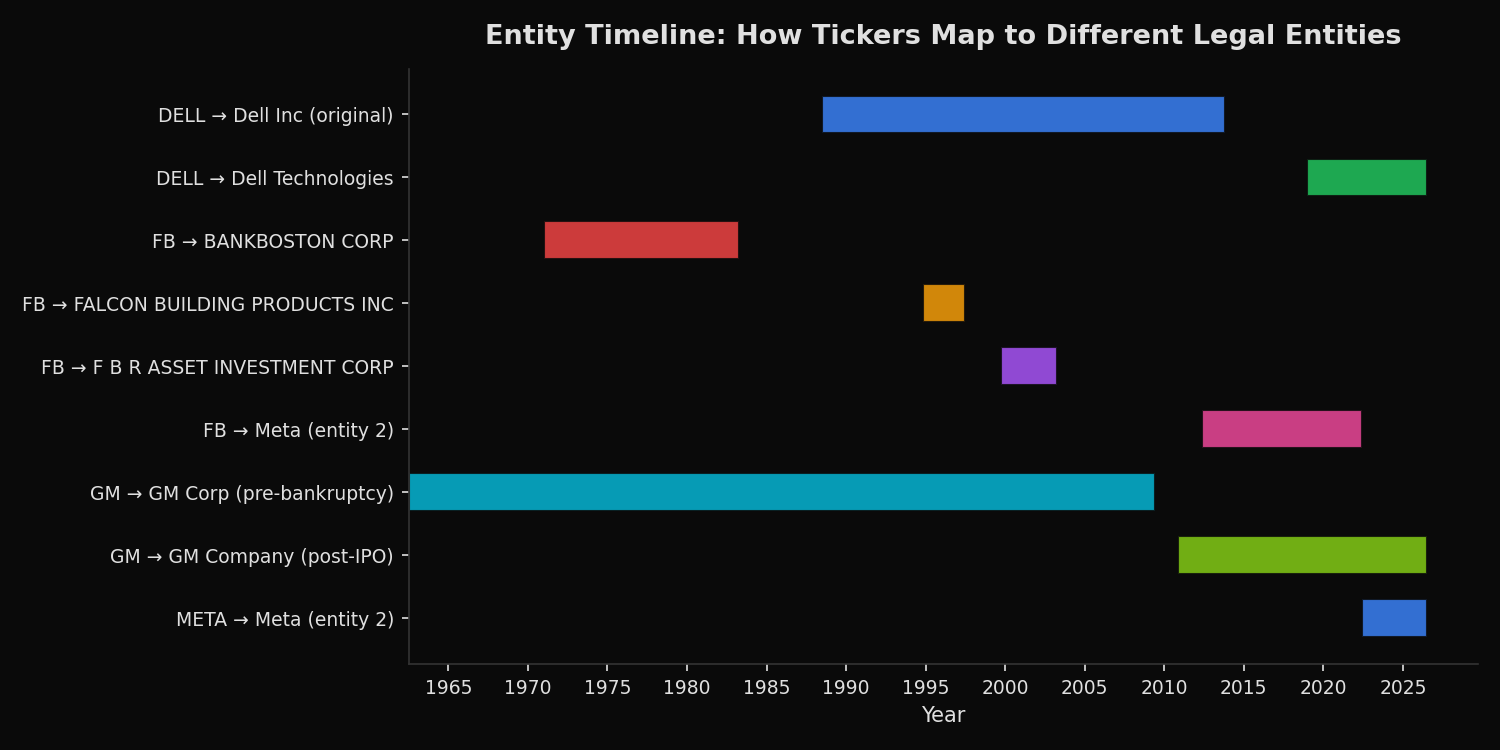
Entity timeline chart showing how tickers META, FB, GM, and DELL map to different legal entities across decades
META — 1 entity(ies):
  Meta Platforms Inc (entity 2): 2022-06-09 to present

FB — 4 entity(ies):
  BANKBOSTON CORP (entity 809): 1971-01-07 to 1983-04-03
  FALCON BUILDING PRODUCTS INC (entity 17829): 1994-11-03 to 1997-06-17
  F B R ASSET INVESTMENT CORP (entity 28677): 1999-09-29 to 2003-03-28
  Meta Platforms Inc (entity 2): 2012-05-18 to 2022-06-08

GM — 2 entity(ies):
  General Motors Corporation (pre-2009 bankruptcy) (entity 4): 1962-07-02 to 2009-06-01
  General Motors Company (entity 5): 2010-11-18 to present

DELL — 2 entity(ies):
  DELL INC (entity 10408): 1988-06-22 to 2013-10-29
  DELL TECHNOLOGIES INC (entity 65047): 2018-12-28 to present

META entity_id: 2
FB->Meta entity_id: 2
Same entity: True

GM entity 4: General Motors Corporation (pre-2009 bankruptcy)
  CIK: 0000040730  |  Ticker: 1962-07-02 to 2009-06-01

GM entity 5: General Motors Company
  CIK: 0001467858  |  Ticker: 2010-11-18 to present

What this tells us

The FB ticker has been assigned to four completely different companies since 1971. Only the most recent occupant is Meta Platforms. Entity resolution confirms that META (valid from 2022-06-09) and FB (valid for Meta from 2012-05-18 to 2022-06-08) both point to entity_id 2. This means any analysis that queries either ticker will correctly map to the same underlying company and its continuous history of SEC filings, financial statements, and price data.

GM illustrates a more consequential case. General Motors Corporation (entity 4) traded from 1962 until June 1, 2009, when it filed for Chapter 11 bankruptcy. Its equity was cancelled and its shareholders were wiped out. General Motors Company (entity 5) is a new legal entity that IPO'd on November 18, 2010, with a different CIK and no continuity of equity ownership from the predecessor. These are two distinct companies in the SEC's records. Treating them as one entity in a backtest would fabricate a return series that bridges a total loss event.

DELL presents a private-then-public gap. Dell Inc (entity 10408) was taken private by Michael Dell and Silver Lake Partners in October 2013. Dell Technologies Inc (entity 65047) returned to public markets in December 2018 after acquiring EMC Corporation and restructuring. There is a five-year gap with no public market data. Stitching the two price histories together would misrepresent the risk profile entirely — the original shareholders received a cash buyout at $13.65 per share, and the new entity debuted at an entirely different valuation.

So what?

Any quantitative workflow that uses ticker symbols as identifiers — backtests, factor models, screening pipelines, or risk systems — is vulnerable to entity confusion. The errors are silent: the data looks normal, the DataFrame has rows, and the numbers are plausible. The analysis is simply wrong.

Entity resolution should be the first step in any pipeline that spans multiple years. Before pulling prices or fundamentals, resolve the ticker to confirm which entity (or entities) it maps to and during which period. For GM, this means deciding whether the analysis covers the pre-bankruptcy or post-IPO entity. For DELL, it means acknowledging the five-year private gap. For FB/META, it means verifying the rename is correctly linked so the full 2012–present history is seamless.

The resolve endpoint returns entity identifiers, validity dates, CIK numbers, and index membership — everything needed to build a survivorship-bias-free dataset. Built from SEC EDGAR public filings and market data, this entity graph ensures that each row in a price or fundamentals DataFrame corresponds to the correct legal entity at the correct point in time.

Built with xfinlink — free financial data API for Python. pip install -U xfinlink

Built with xfinlink — free financial data API for Python. pip install -U xfinlink
← All articles